WELCOME FRIENDS!!

WELCOME  FRIENDS!!
HUMMINGBIRD MIGRATION 2014
Showing posts with label Wikipedia Page Shared. Show all posts

Monday, September 22, 2014

THE LAST SUNSET OF SUMMER-HELLO FALL!!


Hi Everybody!!
Tonight is the night the Fall arrives! At 9:29pm, summer will officially be over as the equinox happens right on time. I have shared info below from the Wikipedia  page on Equinox to answer all your questions. The past week has been incredible with hundreds of hummingbirds. I have been covered up with birds, bees, sugar water, guest birders and photographers witnessing this annual event at Kates Cabin Bird Sanctuary in Texas. I likely have the smallest hummingbird resort, but I have among the most guest hummers enjoying the water park and feeding stations.  (Yes, Mom, you were right:  If I build it, they will come!) Sadly, now right on time, they have gone.


http://en.wikipedia.org/wiki/Equinox

Equinox

From Wikipedia, the free encyclopedia
An equinox occurs twice a year, around 20 March and 22 September. The word itself has several related definitions. The oldest meaning is the day when daytime and night are of approximately equal duration.[2] The word equinox comes from this definition, derived from the Latin aequus(equal) and nox (night). The equinox is not exactly the same as the day when period of daytime and night are of equal length for two reasons. Firstly, sunrise, which begins daytime, occurs when the top of the Sun's disk rises above the eastern horizon. At that instant, the disk's center is still below the horizon. Secondly, Earth's atmosphere refracts sunlight. As a result, an observer sees daylight before the first glimpse of the Sun's disk above the horizon. To avoid this ambiguity, the word equilux is sometimes used to mean a day on which the periods of daylight and night are equal.[3][note 1] Times of sunset and sunrise vary with an observer's location (longitude and latitude), so the dates when day and night are of exactly equal length likewise depend on location.
The other definitions are based on several related simultaneous astronomical events, and refer either to the events themselves or to the days on which they occur. These events are the reason that the period of daytime and night are approximately equal on the day of an equinox.
An equinox occurs when the plane of Earth's Equator passes the center of the Sun. At that instant, the tilt of Earth's axis neither inclines away from nor towards the Sun. The two annual equinoxes are the only times when the subsolar point—the place on Earth's surface where the center of the Sun is exactly overhead—is on the Equator, and, conversely, the Sun is at zenith over the Equator. The subsolar point crosses the equator, moving northward at the March equinox and southward at the September equinox.

During an equinox, the Earth's North and South poles are not tilted toward or away from the Sun, and the duration of daylight is theoretically the same at all points on Earth's surface.
At an equinox, the Sun is at one of the two opposite points on the celestial sphere where the celestial equator (i.e.declination 0) and ecliptic intersect. These points of intersection are called equinoctial points: classically, the vernal point(RA = 00h 00m 00s and longitude = 0°) and the autumnal point (RA = 12h 00m 00s and longitude = 180°).
The equinoxes are the only times when the solar terminator is perpendicular to the Equator. As a result, the Northern and Southern Hemispheres are illuminated equally.
UT date and time of
equinoxes and solstices on Earth[1]
eventequinoxsolsticeequinoxsolstice
monthMarchJuneSeptemberDecember
year
daytimedaytimedaytimedaytime
20102017:322111:282303:092123:38
20112023:212117:162309:042205:30
20122005:142023:092214:492111:12
20132011:022105:042220:442117:11
20142016:572110:512302:292123:03
20152022:452116:382308:202204:48
20162004:302022:342214:212110:44
20172010:282104:242220:022116:28
20182016:152110:072301:542122:23
20192021:582115:542307:502204:19
20202003:502021:442213:312110:02

Length of equinoctial day and night


Contour plot of the hours of daylight as a function of latitude and day of the year, showing approximately 12 hours of daylight at all latitudes during the equinoxes
On the day of the equinox, the center of the Sun spends a roughly equal amount of time above and below the horizon at every location on the Earth, so night and day are about the same length. The word equinox derives from the Latin words aequus (equal) and nox (night). In reality, the day is longer than the night at an equinox. Day is usually defined as the period when sunlight reaches the ground in the absence of local obstacles. From the Earth, the Sun appears as a disc rather than a point of light, so when the center of the Sun is below the horizon, its upper edge is visible. Furthermore, the atmosphere refracts light, so even when the upper limb of the Sun is 0.4 degrees below the horizon, its rays curve over the horizon to the ground. In sunrise/sunset tables, the assumed semidiameter (apparent radius) of the Sun is 16 minutes of arc and the atmospheric refraction is assumed to be 34 minutes of arc. Their combination means that when the upper limb of Sun is on the visible horizon, its center is 50 minutes of arc below the geometric horizon, which is the intersection with the celestial sphere of a horizontal plane through the eye of the observer. These effects make the day about 14 minutes longer than the night at the Equator and longer still towards the Poles. The real equality of day and night only happens in places far enough from the Equator to have a seasonal difference in day length of at least 7 minutes, actually occurring a few days towards the winter side of each equinox.
Because the Sun is a spherical (rather than a single-point) source of light, the actual crossing of the Sun over the Equator takes approximately 33 hours.[citation needed]
At the equinoxes, the rate of change for the length of daylight and night-time is the greatest. At the poles, the equinox marks the start of the transition from 24 hours of nighttime to 24 hours of daylight (or vice versa). Far north of the Arctic Circle, at LongyearbyenSvalbardNorway, there is an additional 15 minutes more daylight every day about the time of the Spring equinox, whereas in Singapore (which is just one degree of latitude north of the Equator), the amount of daylight in each daytime varies by just a few seconds.[citation needed]


Link to Photo Album Gallery:
https://plus.google.com/u/0/photos/117645114459863049265/albums/6061973854452458113
The Last Sunset of Summer


The Hummingbird Migration 2014
Good news: I had a feeling yesterday they were getting ready to go on to Mexico. I shot 10001 pics yesterday, the best day! I have averaged 500 pics a day since Sept 1, 2014. I tried to capture all parts of the migration and all positions of birds. At one point, there were over 400 tiny birds here! I will be editing and posting these pics for quite a while! Stay tuned!


...this is brendasue signing off from Rainbow Creek.  See you next time! Happy Fall for All!!!!!!!!!!!!!!!!

O+O

Tuesday, September 16, 2014

HOW TO FEED THE HUMMINGBIRDS-HUMMINGBIRD MIGRATION 2014


Hi Everybody!!
Some of the new people to birding may want to know how to feed the hummingbirds. Shared below is a Wikipedia page with the details. Every year I add new feeders as more birds come in. I estimate there are between 250 and 300 outside today. The adult males arrived about 10 days before the females and young began coming in.  With all the new birds, there are still only 10 of the breeder males. They definitely run the show! Your photostudy is highlights from 8-19 (before the females came in). Enjoy!


Highlights of August 19, 2014
(Please go to album links for complete daily photostudy throughout the migration).
https://plus.google.com/u/0/photos/117645114459863049265/albums/6057388208177114225


juvenile male flies to feeder where he hovers in place.


YUM!!


Adult Male Ruby-Throated Hummer


https://en.wikipedia.org/wiki/Hummingbird

Hummingbird

From Wikipedia, the free encyclopedia

Diet and specializations for food gathering[edit]


Green violetear at a flower.
File:Hummingbird.ogg
Hummingbird in Copiapó, Chile
Hummingbirds drink nectar, a sweet liquid inside certain flowers. Like bees, they are able to assess the amount of sugar in the nectar they eat; they normally reject flower types that produce nectar that is less than 10% sugar and prefer those whose sugar content is higher. Nectar is a mixture of glucosefructose, and sucrose, and is a poor source of nutrients, so hummingbirds meet their needs for proteinamino acidsvitaminsminerals, etc. by preying on insects and spiders.[58]
Hummingbird bill shapes vary dramatically, as an adaptation for specialized feeding. Some species, such as hermits (Phaethornis spp.) have bills that are long allowing them to probe deep into flowers that have a long corolla. Thornbills have short, sharp bills adapted for feeding from flowers with short corollas and piercing the bases of longer ones. The sicklebills' extremely decurved bills are adapted to extracting nectar from the curved corollas of flowers in the familyGesneriaceae. The bill of the fiery-tailed awlbill has an upturned tip, as in the avocets. The male tooth-billed hummingbird has barracuda-like spikes at the tip of its long, straight bill.
The two halves of a hummingbird's bill have a pronounced overlap, with the lower half (mandible) fitting tightly inside the upper half (maxilla). When hummingbirds feed on nectar, the bill is usually opened only slightly, allowing the tongue to dart out and into the interior of flowers.
Hummingbirds drink with their tongue by rapidly lapping nectar. Their tongues have tubes which run down their lengths and help the hummingbirds drink the nectar. While it had been believed that capillary action was what drew nectar into these tubes, high-speed photography has revealed that the tubes open down their sides as the tongue goes into the nectar, and then close around the nectar, trapping it so it can be pulled back into the beak.[59][60] Consequently, tongue flexibility enables accessing, transporting and unloading nectar.[61]
Hummingbirds do not spend all day flying, as the energy cost would be prohibitive; the majority of their activity consists simply of sitting or perching. Hummingbirds eat many small meals and consume approximately half their weight in pure sugar (twice their weight in nectar, if the nectar is 25% sugar) each day.[62] Hummingbirds digest their food rapidly due to their small size and high metabolism; a mean retention time (MRT) of less than an hour has been reported.[63] Hummingbirds spend an average of 10–15% of their time feeding and 75–80% sitting and digesting.
Because they starve so easily, hummingbirds are highly attuned to food sources. Some species, including many found in North America, are territorial and will try to guard food sources (such as a feeder) against other hummingbirds, attempting to ensure a future food supply for itself.

Feeders and artificial nectar[edit]


Hummingbirds will either hover or perch to feed; red feeders are preferred, but colored liquid is not necessary.
In the wild, hummingbirds visit flowers for food, extracting nectar, which is 55% sucrose, 24% glucose and 21% fructose.[64] Hummingbirds will also take sugar-water from bird feeders. Such feeders allow people to observe and enjoy hummingbirds up close while providing the birds with a reliable source of energy, especially when flower blossoms are less abundant. A negative aspect of artificial feeders, however, is that the birds may seek less flower nectar for food, and so reduce the amount of pollination their feeding naturally provides.[65]
White granulated sugar is the best sweetener to use in hummingbird feeders. A ratio of 1 part sugar to 4 parts water (20% sugar) is a common recipe,[66]although hummingbirds will defend feeders more aggressively when sugar content is at 35%, indicating preference for nectar with higher sweetness and sugar content.[67] Boiling and then cooling this mixture before use has been recommended to help deter the growth of bacteria and fungi. Powdered sugars contain corn starch as an anti-caking agent which can contribute to premature fermentation of the solution. Brown, turbinado, and "raw" sugars contain iron, which can be deadly to hummingbirds if consumed over long periods.[68] Honey is made by bees from the nectar of flowers, but it is not good to use in feeders because when it is diluted with water, microorganisms easily grow in it, causing it to spoil rapidly.[69][70][71]
Red food dye is often added to homemade solutions, however is not necessary and may be harmful to the birds. Commercial products sold as "instant nectar" or "hummingbird food" may also contain preservatives and/or artificial flavors as well as dyes. The long-term effects of these additives on hummingbirds have not been studied.[72] Although some commercial products contain small amounts of nutritional additives, hummingbirds obtain all necessary nutrients from the insects they eat. This renders the added nutrients unnecessary in most situations.[54]

Hummingbirds hovering at an artificial nectar feeder
Other animals also visit hummingbird feeders. Bees, wasps, and ants are attracted to the sugar-water and may crawl into the feeder, where they may become trapped and drown. Orioleswoodpeckersbananaquits, and other larger animals are known to drink from hummingbird feeders, sometimes tipping them and draining the liquid.[73] In the southwestern United States, two species of nectar-drinking bats (Leptonycteris yerbabuenae andChoeronycteris mexicana) visit hummingbird feeders to supplement their natural diet of nectar and pollen from saguaro cacti and agaves.[74]

Systematics[edit]


A color plate illustration from Ernst Haeckel's Kunstformen der Natur(1899), showing a variety of hummingbirds.
In traditional taxonomy, hummingbirds are placed in the order Apodiformes, which also contains the swifts. However, some taxonomists have separated them into their own order, Trochiliformes. Hummingbirds' wing bones are hollow and fragile, making fossilization difficult and leaving their evolutionary history poorly documented. Though scientists theorize that hummingbirds originated in South America, where there is the greatest species diversity, possible ancestors of extant hummingbirds may have lived in parts of Europe to what is southern Russia today.[7]
There are between 325 and 340 species of hummingbird, depending on taxonomic viewpoint, divided into two subfamilies, the hermits (subfamilyPhaethornithinae, 34 species in six genera), and the typical hummingbirds (subfamily Trochilinae, all the others). However, recent phylogenetic analyses suggest that this division is slightly inaccurate, and that there are nine major clades of hummingbirds: the topazes and jacobins, the hermits, themangoes, the coquettes, the brilliants, the giant hummingbird (Patagona gigas), the mountain-gems, the bees, and the emeralds.[8] The topazes and jacobins combined have the oldest split with the rest of the hummingbirds. The hummingbird family has the second greatest number of species of any bird family on Earth (after the tyrant flycatchers).
Fossil hummingbirds are known from the Pleistocene of Brazil and the Bahamas; however, neither has yet been scientifically described, and there are fossils and subfossils of a few extant species known. Until recently, older fossils had not been securely identifiable as those of hummingbirds.
In 2004, Dr Gerald Mayr of the Senckenberg Museum in Frankfurt am Main identified two 30-million-year-old hummingbird fossils and published his results in the journal Science.[9] The fossils of this primitive hummingbird species, named Eurotrochilus inexpectatus ("unexpected European hummingbird"), had been sitting in a museum drawer in Stuttgart; they had been unearthed in a clay pit at Wiesloch–Frauenweiler, south of Heidelberg,Germany, and, because it was assumed that hummingbirds never occurred outside the Americas, were not recognized to be hummingbirds until Mayr took a closer look at them.
Fossils of birds not clearly assignable to either hummingbirds or a related, extinct family, the Jungornithidae, have been found at the Messel pit and in theCaucasus, dating from 40–35 mya; this indicates that the split between these two lineages indeed occurred at that date. The areas where these early fossils have been found had a climate quite similar to that of the northern Caribbean or southernmost China during that time. The biggest remaining mystery at the present time is what happened to hummingbirds in the roughly 25 million years between the primitive Eurotrochilus and the modern fossils. The astounding morphological adaptations, the decrease in size, and the dispersal to the Americas and extinction in Eurasia all occurred during this timespan. DNA-DNA hybridization results[10] suggest that the main radiation of South American hummingbirds took place at least partly in the Miocene, some 12 to 13 million years ago, during the uplifting of the northern Andes.
In 2013, a 50-million-year-old fossil bird unearthed in Wyoming was found to be a predecessor to both hummingbirds and swifts before the groups diverged.[11]


guarding his feeder!


...this is brendasue signing off from Rainbow Creek.  See you next time! Have a "Hummer Day"!!


O+O

Sunday, August 24, 2014

EXACTLY WHAT IS A BIRD SANCTUARY?


Hi Everybody!!
If you "Google" Bird Sanctuary, you will discover many ideas of what a Sanctuary is. I built Kates Cabin Bird Sanctuary to be a safe refuge for birds to eat, nest and play. This is a very small private space (not open to public) of one acre on a little creek in Northern Waller County, Texas. I began creating this space as a Memory Garden for my Mom and Dad, who left the planet 10 years ago. I moved the heavy concrete cross from the Farm to be the heart of the garden. I have never had an injured bird to care for. Now I do. This bird was brought here by the Mother Bird and placed in the Memory Garden. She has a broken leg that can not be fixed (by me). She is a baby Turkey Buzzard. I named her Cassidy (after Hop Along). Of course, you do not believe me about my strange encounters with wildlife. That is why I take photos!  Enjoy!


Introducing: Cassidy-A Baby Buzzard w/Broken Leg
(See G+Photo Album for all pics on july 26):  https://plus.google.com/u/0/photos/117645114459863049265/albums/6041987839328167025


They arrived at my front gate in July


I could tell her leg was broken or deformed


She still has the baby fuzz around her neck


To me she appears to be very cute


Cassidy's problem is only one good leg


She can move in hops


She is a Turkey Buzzard (Wikipedia Info shared below)


Cassidy is a modern dinosaur!

https://en.wikipedia.org/wiki/Turkey_vulture

Turkey vulture

From Wikipedia, the free encyclopedia
The turkey vulture (Cathartes aura), also known in some North American regions as the turkey buzzard (or just buzzard), and in some areas of the Caribbean as the John crow or carrion crow,[2] is the most widespread of the New World vultures.[3] One of three species in the genus Cathartes, in the family Cathartidae, the turkey vulture ranges from southern Canada to the southernmost tip of South America. It inhabits a variety of open and semi-open areas, including subtropical forests, shrublands, pastures, and deserts.[1]
It, like all New World vultures, is not related to the Old World vultures of Europe, Africa, and Asia. It looks nearly identical because of convergent evolution, where natural selection similarly shapes unrelated animals adapting to the same conditions.
The turkey vulture is a scavenger and feeds almost exclusively on carrion.[4] It finds its food using its keen eyes and sense of smell, flying low enough to detect the gases produced by the beginnings of the process of decay in dead animals.[4] In flight, it uses thermals to move through the air, flapping its wings infrequently. It roosts in large community groups. Lacking a syrinx—the vocal organ of birds—its only vocalizations are grunts or low hisses.[5]It nests in caves, hollow trees, or thickets. Each year it generally raises two chicks, which it feeds by regurgitation.[6] It has very few natural predators.[7]In the United States, the vulture receives legal protection under the Migratory Bird Treaty Act of 1918.[8]
Turkey vulture
Cathartes aura -Santa Teresa County Park, San Jose, California, USA -adult-8a.jpg
At Santa Teresa County Park, San Jose, California, US
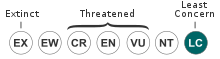
Conservation status
Scientific classification
Kingdom:Animalia
Phylum:Chordata
Class:Aves
Order:Cathartiformes
Family:Cathartidae
Genus:Cathartes
Species:C. aura
Binomial name
Cathartes aura
(Linnaeus, 1758)
Turkeyvulturerange.jpg
Range of C. aura     Summer only range     Winter only range

Description[edit]

A large bird, it has a wingspan of 160–183 cm (63–72 in), a length of 62–81 cm (24–32 in), and weight of 0.8 to 2.3 kg (1.8 to 5.1 lb).[22][23][24] While birds in the northern limit of the species' range average around 2 kg (4.4 lb), vulture from the neotropics are generally smaller, averaging around 1.45 kg (3.2 lb).[25][26] It displays minimal sexual dimorphism; sexes are identical in plumage and in coloration, although the female is slightly larger.[27] The body feathers are mostly brownish-black, but the flight feathers on the wings appear to be silvery-gray beneath, contrasting with the darker wing linings.[22] The adult's head is small in proportion to its body and is red in color with few to no feathers. It also has a relatively short, hooked, ivory-colored beak.[28] The irises of the eyes are gray-brown; legs and feet are pink-skinned, although typically stained white. The eye has a single incomplete row of eyelashes on the upper lid and two rows on the lower lid.[29]
The two front toes of the foot are long and have small webs at their bases.[30] Tracks are large, between 9.5 and 14 cm (3.7 and 5.5 in) in length and 8.2 and 10.2 cm (3.2 and 4.0 in) in width, both measurements including claw marks. Toes are arranged in the classic, anisodactyl pattern.[31] The feet are flat, relatively weak, and poorly adapted to grasping; the talons are also not designed for grasping, as they are relatively blunt.[3] In flight, the tail is long and slim. The black vulture is relatively shorter-tailed and shorter-winged, which makes it appear rather smaller in flight than the turkey vulture, although the body masses of the two species are roughly the same. The nostrils are not divided by a septum, but rather are perforate; from the side one can see through the beak.[32] It undergoes a molt in late winter to early spring. It is a gradual molt, which lasts until early autumn.[6] The immature bird has a gray head with a black beak tip; the colors change to those of the adult as the bird matures.[33] Captive longevity is not well known. While 21 years is generally given as a maximum age, the Gabbert Raptor Center on the University of Minnesota campus is home to a turkey vulture named Nero with a confirmed hatch year of 1974.[clarification needed] There is another female bird, named Richard, living at the Lindsay Wildlife Museum in Walnut Creek, CA that hatched in 1974 and arrived at the museum later that year.[34] The oldest wild captured banded bird was 16 years old.[4]
Leucistic (sometimes mistakenly called "albino") turkey vultures are sometimes seen.[35] The well-documented records come from the United States of America, but this probably reflects the fact that such birds are more commonly reported by birders there, rather than a geographical variation. Even in the United States, white turkey vultures (although they presumably always turned up every now and then) were only discussed in birder and raptor conservation circles and are not scientifically studied.[36]
The turkey vulture, like most other vultures, has very few vocalization capabilities. Because it lacks a syrinx, it can only utter hisses and grunts.[5] It usually hisses when it feels threatened, or when fighting with other vultures over a carcass. Grunts are commonly heard from hungry young and from adults in their courtship display.

Distribution and habitat[edit]

The turkey vulture has a large range, with an estimated global occurrence of 28,000,000 km2 (11,000,000 sq mi). It is the most abundant vulture in the Americas.[3] Its global population is estimated to be 4,500,000 individuals.[1] It is found in open and semi-open areas throughout the Americas from southern Canada to Cape Horn. It is a permanent resident in the southern United States, though northern birds may migrate as far south as South America.[4] The turkey vulture is widespread over open country, subtropical forests, shrublands, deserts, and foothills.[37] It is also found in pastures, grasslands, and wetlands.[1] It is most commonly found in relatively open areas which provide nearby woods for nesting and it generally avoids heavily forested areas.[22]
This bird with its crow-like aspect gave foot to the naming of the Quebrada de los Cuervos (Crows Ravine) in Uruguay, where they dwell together with the lesser yellow-headed vulture and theblack vulture.[38]

Ecology and behavior[edit]


Spread-winged adult
The turkey vulture is gregarious and roosts in large community groups, breaking away to forage independently during the day. Several hundred vultures may roost communally in groups which sometimes even include black vultures. It roosts on dead, leafless trees, and will also roost on man-made structures such as water or microwave towers. Though it nests in caves, it does not enter them except during the breeding season.[6] The turkey vulture lowers its night-time body temperature by about 6 degrees Celsius to 34 °C (93 °F), becoming slightly hypothermic.[30]
This vulture is often seen standing in a spread-winged stance. The stance is believed to serve multiple functions: drying the wings, warming the body, and baking off bacteria. It is practiced more often following damp or rainy nights. This same behavior is displayed by other New World vultures, by Old World vultures, and by storks.[7] Like storks, the turkey vulture often defecates on its own legs, using the evaporation of the water in the feces and/or urine to cool itself, a process known as urohidrosis.[39] It cools the blood vessels in the unfeathered tarsi and feet, and causes white uric acid to streak the legs.[40] The turkey vulture has few natural predators. Adult, immature and fledging vultures may fall prey to golden eaglesbald eagles and great horned owls, while eggs and nestlings may be preyed on by mammals such as raccoonsVirginia opossum and foxes.[7][23] Its primary form of defense is regurgitating semi-digested meat, a foul-smelling substance which deters most creatures intent on raiding a vulture nest.[6] It will also sting if the predator is close enough to get the vomit in its face or eyes. In some cases, the vulture must rid its crop of a heavy, undigested meal in order to take flight to flee from a potential predator.[28] Its life expectancy in the wild ranges upward of 16 years, with a captive life span of over 30 years being possible.[41][42]
The turkey vulture is awkward on the ground with an ungainly, hopping walk. It requires a great deal of effort to take flight, flapping its wings while pushing off the ground and hopping with its feet.[28] While soaring, the turkey vulture holds its wings in a shallow V-shape and often tips from side to side, frequently causing the gray flight feathers to appear silvery as they catch the light. The flight of the turkey vulture is an example of static soaring flight, in which it flaps its wings very infrequently, and takes advantage of rising thermals to stay soaring.[43]

Diet[edit]


Feeding on dead gull at Morro Bay, California
The turkey vulture feeds primarily on a wide variety of carrion, from small mammals to large grazers, preferring those recently dead, and avoiding carcasses that have reached the point of putrefaction. They may rarely feed on plant matter, shoreline vegetation, pumpkin and other crops, live insects and other invertebrates.[37] In South America, turkey vultures have been photographed feeding on the fruits of the introduced oil palm.[44][45][46] They rarely, if ever, kill prey themselves.[47] The turkey vulture can often be seen along roadsides feeding on roadkill, or near bodies of water, feeding on washed-up fish.[4] They also will feed on fish or insects which have become stranded in shallow water.[6] Like other vultures, it plays an important role in the ecosystem by disposing of carrion which would otherwise be a breeding ground for disease.[48]
The turkey vulture forages by smell, an ability that is uncommon in the avian world, often flying low to the ground to pick up the scent of ethyl mercaptan, a gas produced by the beginnings of decay in dead animals.[7] The olfactory lobe of its brain, responsible for processing smells, is particularly large compared to that of other animals.[7] This heightened ability to detect odors allows it to search for carrion below the forest canopy.King vulturesblack vultures, and condors, which lack the ability to smell carrion, follow the turkey vulture to carcasses. The turkey vulture arrives first at the carcass, or with greater yellow-headed vultures or lesser yellow-headed vultures, which also share the ability to smell carrion.[7] It displaces the yellow-headed vultures from carcasses due to its larger size,[48] but is displaced in turn by the king vulture and both types of condor, which make the first cut into the skin of the dead animal. This allows the smaller, weaker-billed, turkey vulture access to food, because it cannot tear the tough hides of larger animals on its own. This is an example of mutual dependence between species.[49]

Reproduction[edit]

The breeding season of the turkey vulture varies according to latitude.[50] In the southern United States, it commences in March, peaks in April to May, and continues into June.[51] In more northerly latitudes, the season starts later and extends into August.[52] Courtship rituals of the turkey vulture involve several individuals gathering in a circle, where they perform hopping movements around the perimeter of the circle with wings partially spread. In the air, one bird closely follows another while flapping and diving.[37]
Eggs are generally laid in the nesting site in a protected location such as a cliff, a cave, a rock crevice, a burrow, inside a hollow tree, or in a thicket. There is little or no construction of a nest; eggs are laid on a bare surface. Females generally lay two eggs, but sometimes one and rarely three. The eggs are cream-colored, with brown or lavender spots around their larger end.[37]Both parents incubate, and the young hatch after 30 to 40 days. Chicks are altricial, or helpless at birth. Both adults feed the chicks by regurgitating food for them, and care for them for 10 to 11 weeks. When adults are threatened while nesting, they may flee, or they may regurgitate on the intruder or feign death.[6] If the chicks are threatened in the nest, they defend themselves by hissing and regurgitating.[37] The young fledge at about nine to ten weeks. Family groups remain together until fall.[37]

Relationship with humans[edit]


A side view, showing the perforated nostrils.
The turkey vulture is sometimes accused of carrying anthrax or hog cholera, both livestock diseases, on its feet or bill by cattle ranchers and is therefore occasionally perceived as a threat.[53] However, the virus that causes hog cholera is destroyed when it passes through the turkey vulture's digestive tract.[28]This species also may be perceived as a threat by farmers due to the similar black vulture's tendency to attack and kill newborn cattle. The turkey vulture does not kill live animals but will mix with flocks of black vultures and will scavenge what they leave behind. Nonetheless, its appearance at a location where a calf has been killed gives the incorrect impression that the turkey vulture represents a danger to calves.[54] The droppings produced by Turkey Vultures and other vultures can harm or kill trees and other vegetation.[55] The turkey vulture can be held in captivity, though the Migratory Bird Treaty Act prevents this in the case of uninjured animals or animals capable of returning to the wild.[56] In captivity, it can be fed fresh meat, and younger birds will gorge themselves if given the opportunity.[28]
The turkey vulture species receives special legal protections under the Migratory Bird Treaty Act of 1918 in the United States,[8] by the Convention for the Protection of Migratory Birds in Canada,[57] and by the Convention for the Protection of Migratory Birds and Game Mammals in Mexico.[57] In the USA it is illegal to take, kill, or possess turkey vultures, and violation of the law is punishable by a fine of up to $15,000 and imprisonment of up to six months.[56] It is listed as a species of Least Concern by the IUCN Red List. Populations appear to remain stable, and it has not reached the threshold of inclusion as a threatened species, which requires a decline of more than 30 percent in ten years or three generations.[1]


...this is brendasue signing off from Rainbow Creek.  See You next time! More adventures of Cassidy next week!

Who Are You???????????
O+O