WELCOME FRIENDS!!

WELCOME  FRIENDS!!
HUMMINGBIRD MIGRATION 2014
Showing posts with label hummingbirds in trees. Show all posts

Sunday, January 11, 2015

HUMMINGBIRD RODEO AT THE MIGRATION REVIEW HIGHLIGHTS OF 9 21 B


Hi Everybody!!
You know I am in Texas if the hummingbirds are having a rodeo! Yahoo! As a young girl, my horse and I participated in the Barrel Racing event. Basically, it was a timed obstacle course circling 3 barrels. I now watch the hummers come out of the trees, circle all the feeders, then return to the trees and I feel as if I am in a Rodeo Arena full of tiny birds! The flying competition is just fantastic as you may notice in today's highlight review of 9 21B. Thanks to Google's 'Auto Awesome' for the special photo effects! Enjoy!


Link to G+ Photo Album:
https://plus.google.com/u/0/photos/117645114459863049265/albums/6073506759902606209


...this is brendasue signing off from Rainbow Creek.  See you next time!

O+O

Saturday, September 6, 2014

HUMMERS HIDING IN THE TREES


Hi Everybody!!
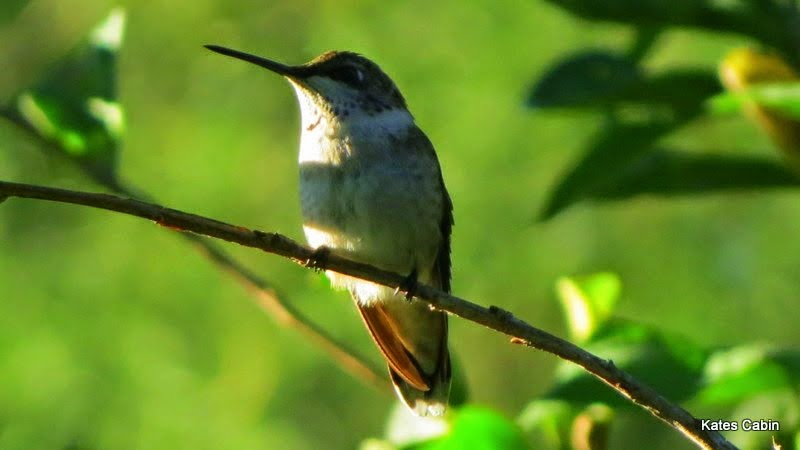
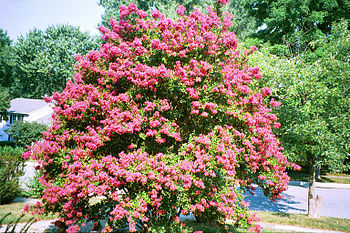
Today we will look at hummingbirds in the trees. The little birds love trees and spend more time in the trees than eating. It is difficult to scan a group of trees and see the hummers. If I see them land, then I can see them as they have a preference for the same branch. Their favorite trees here at the Bird Sanctuary are the crepe myrtles that range in size from miniatures to tall trees. I have shared info from Wikipedia on Crepe Myrtles. You can also "Google Search" trees that attract hummingbirds, to discover what trees will grow in your area. The birds travel all the way to Canada and return to Mexico. It is challenging to look at trees and see the birds, but is does get easier with practice. Try it and Enjoy!


https://plus.google.com/u/0/photos/117645114459863049265/albums/6055248383099775649


https://en.wikipedia.org/wiki/Lagerstroemia

Lagerstroemia

From Wikipedia, the free encyclopedia
Lagerstroemia /ˌlɡərˈstrmiə/,[1] commonly known as crape myrtle or crepe myrtle, is a genus of around 50 species of deciduous and evergreentrees and shrubs native to the Indian Subcontinent, southeast Asia, northern Australia, and parts of Oceania, cultivated in warmer climates around the world. It is a member of the Lythraceae, which are also known as the loosestrife family. The genus is named after the Swedish merchant Magnus von Lagerström, who supplied Carolus Linnaeus with plants he collected. These flowering trees are beautifully colored and are often planted both privately and commercially. Popular cultivars used in modern landscaping include the bright red 'Dynamite', the deep pink 'Pink Velour', and the purple 'Twilight' crape myrtle, which also has a bark that changes colors.
Crape myrtle
Lagerstroemia indica Blanco1.207.png
Lagerstroemia indica
Scientific classification
Kingdom:Plantae
(unranked):Angiosperms
(unranked):Eudicots
(unranked):Rosids
Order:Myrtales
Family:Lythraceae
Genus:Lagerstroemia
Linnaeus

A 12-ft (4-m) crape myrtle in Lutherville, Maryland
The common crape myrtle (Lagerstroemia indica) from China and Korea was introduced circa 1790 to Charleston, South Carolina, in the United States by the French botanist André Michaux. In the wild, the species is most often found as a multistemmed large shrub, but 200 years of cultivation have resulted in a huge number of cultivars of widely varying characteristics. Today, crape myrtle varieties can fill every landscape need, from tidy street trees to dense barrier hedges to fast-growing dwarf types of less than two feet, which can go from seed to bloom in a season (allowing gardeners in places where the plant is not winter-hardy to still enjoy the intense colors of the frilly flowers). In Europe, crape myrtle is common in the south of France, theIberian Peninsula and all of Italy; in the United States, it can be seen anywhere south of USDA zone 6, doing best and avoiding fungal diseases in mild climates that are not overly humid, such as inland California and Texas.
(See link for complete Text)


...this is brendasue signing off from Rainbow Creek.  See you next time!

O+O