WELCOME FRIENDS!!

WELCOME  FRIENDS!!
HUMMINGBIRD MIGRATION 2014
Showing posts with label apricot tree. Show all posts

Thursday, March 19, 2015

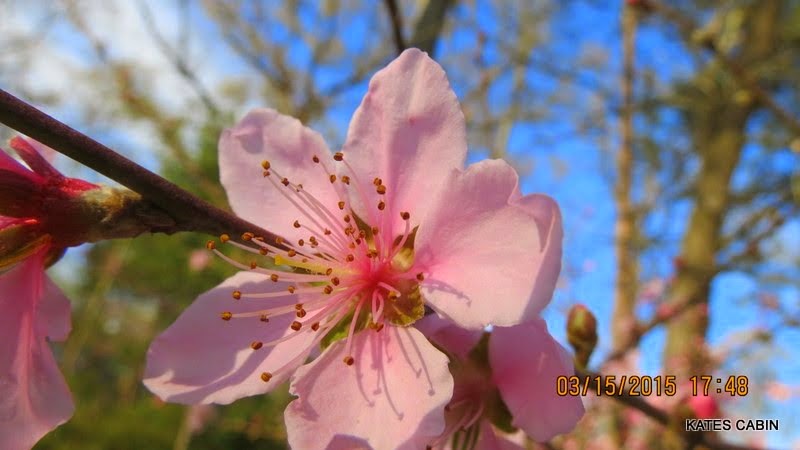
PRETTY IN PINK: THE APRICOT TREE!


Hi Everybody!!
Welcome back to the Spring Parade of Blooms in progress now at Kates Cabin Bird Sanctuary. Today we are looking at the gorgeous pink blossoms of the Apricot Tree, who is really putting on a show this year! This tree was adapted to grow in Texas with less chill hours required to produce fruit (unlike varieties that grow up North). I have shared below a Wikipedia excerpt with info on Apricots, for those of you wanting to know more about this tree. Find the right tree for your growing zone and you will enjoy this tree for many years. Enjoy!


link to G+ Photo Album:
https://plus.google.com/u/0/photos/117645114459863049265/albums/6127756262910932609


Info from Wikipedia Page:
https://en.wikipedia.org/wiki/Apricot
An apricot is a fruit or the tree that bears the fruit. Usually, an apricot tree is from the tree species Prunus armeniaca, but the species Prunus brigantinaPrunus mandshuricaPrunus mume, and Prunus sibirica are closely related, have similar fruit, and are also called apricots.[1]

The apricot is a small tree, 8–12 m (26–39 ft) tall, with a trunk up to 40 cm (16 in) in diameter and a dense, spreading canopy. The leaves are ovate, 5–9 cm (2.0–3.5 in) long and 4–8 cm (1.6–3.1 in) wide, with a rounded base, a pointed tip and a finely serrated margin. The flowers are 2–4.5 cm (0.8–1.8 in) in diameter, with five white to pinkish petals; they are produced singly or in pairs in early spring before the leaves. The fruit is a drupesimilar to a small peach, 1.5–2.5 cm (0.6–1.0 in) diameter (larger in some modern cultivars), from yellow to orange, often tinged red on the side most exposed to the sun; its surface can be smooth (botanically described as: glabrous) or velvety with very short hairs (botanically: pubescent). The flesh is usually firm and not very juicy. Its taste can range from sweet to tart. The single seed is enclosed in a hard, stony shell, often called a "stone", with a grainy, smooth texture except for three ridges running down one side.[2][3]
The origin of the apricot is disputed. It was known in Armenia during ancient times, and has been cultivated there for so long that it is often thought to have originated there.[4][5] Its scientific name Prunus armeniaca (Armenian plum) derives from that assumption. For example, the Belgian arboristbaron de Poerderlé, writing in the 1770s, asserted, "Cet arbre tire son nom de l'Arménie, province d'Asie, d'où il est originaire et d'où il fut porté en Europe ..." ("this tree takes its name from Armenia, province of Asia, where it is native, and whence it was brought to Europe ...").[6] An archaeological excavation at Garni in Armenia found apricot seeds in an Eneolithic-era site.[7] Despite the great number of varieties of apricots that are grown in Armenia today (about 50),[5] according to the Soviet botanist Nikolai Vavilov its center of origin would be the Chinese region, where the domestication of apricot would have taken place. Other sources say that the apricot was first cultivated in India in about 3000 BC.[8]
Its introduction to Greece is attributed to Alexander the Great;[8] later, the Roman General Lucullus (106–57 BC) also would have imported some trees – the cherry, white heart cherry, and apricot – from Armenia to Rome[citation needed]. Subsequent sources were often confused about the origin of the species. John Claudius Loudon (1838) believed it had a wide native range including Armenia, the Caucasus, the HimalayasChina, and Japan.[9]
Apricots have been cultivated in Persia since antiquity, and dried ones were an important commodity on Persian trade routes. Apricots remain an important fruit in modern-day Iran, where they are known under the common name of zard-ālū (Persian: زردآلو).
Egyptians usually dry apricots, add sweetener, and then use them to make a drink called amar al-dīn.
In the 17th century, English settlers brought the apricot to the English colonies in the New World. Most of modern American production of apricots comes from the seedlings carried to the west coast by Spanish missionaries. Almost all U.S. commercial production is in California, with some inWashington and Utah.[10]
Many apricots are also cultivated in Australia, particularly South Australia, where they are commonly grown in the region known as the Riverland and round the small town of Mypolonga in the Lower Murray region of the state. In states other than South Australia, apricots are still grown, particularly inTasmania and western Victoria and southwest New South Wales, but they are less common than in South Australia.
Today, apricot cultivation has spread to all parts of the globe with climates that support it.




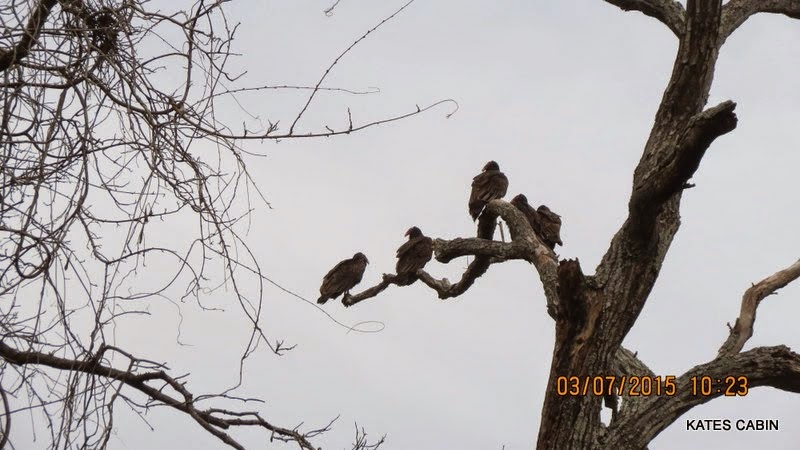
The last days of the Buzzard Migration


Link to G+ Photo Album:
https://plus.google.com/u/0/photos/117645114459863049265/albums/6123961206382987393





...this is brendasue signing off from Rainbow Creek.  See you next time!

O+O

Monday, March 9, 2015

A FRUITY PARADE OF BLOOMS AND A SPRING BIRD


Hi Everybody!!
Today some fruity flowers join the Spring Parade of Blooms! When I see these beautiful apple blossoms, I also imagine the apple pie I will be making this summer. Somehow seeing the flowers, then the baby apples growing, adds to the excellent taste! The photostudy below shows several fruit trees starting their spring bloom. I have included links to Wikipedia Pages for more info about these trees. I encourage you all to plant fruit trees.(Check what will grow in your area).  I add new baby trees every year. Enjoy!


link to G+ Photo Album:
https://plus.google.com/u/0/photos/117645114459863049265/albums/6123944840890542337


https://en.wikipedia.org/wiki/Granny_Smith
The Granny Smith is a tip-bearing apple cultivar, which originated in Australia in 1868.[1] It is named after Maria Ann Smith, who propagated the cultivar from a chance seedling. The tree is thought to be a hybrid of Malus sylvestris, the European Wild Apple, with the domestic apple M. domestica as the polleniser. The fruit has hard, light green skin and a crisp, juicy flesh.
Malus 'Granny Smith'
Granny smith and cross section.jpg
Hybrid parentageThought to be
Malus domestica × M. sylvestris
CultivarGranny Smith
OriginMaria Ann Smith
Australia, 1868


Honeybee pollinating flower


Purple Leaf Plum Tree blooms


https://en.wikipedia.org/wiki/Cherry_plum
Prunus cerasifera is a species of plum known by the common names cherry plum and myrobalan plum.[2] It is native to Europe[3] and Asia.[2]
Wild types are large shrubs or small trees reaching 6-15 m tall, with deciduous leaves 4-6 cm long. It is one of the first European trees to flower in spring, often starting in mid-February. The flowers are white and about 2 cm across, with five petals. The fruit is a drupe, 2-3 cm in diameter, and yellow or red in colour. It is edible, and reaches maturity from early July to mid-September.
This species can be found growing wild where it has escaped cultivation and become naturalized, such as in North America.[4][5]
Cultivated cherry plums can have fruits, foliage, and flowers in any of several colors. Some varieties have sweet fruits that can be eaten fresh, while others are sour and better for making jam.
Cherry plums are a key ingredient in Georgian cuisine where they are used to produce tkemali sauce, as well as a number of popular dishes, such askharcho soup and chakapuli stew.
The cherry plum is a popular ornamental tree for garden and landscaping use, grown for its very early flowering. Numerous cultivars have been developed, many of them selected for purple foliage, such as 'Atropurpurea'.[6][7] These purple-foliage forms (often called purple-leaf plum), also have dark purple fruit, which make an attractive, intensely coloured jam. They can have white or pink flowers. The cultivar 'Thundercloud' has bright red foliage which darkens purple.[8] Others, such as 'Lindsayae', have green foliage. Some kinds of purple-leaf plums are used for bonsai[7] and other forms of living sculpture.
The variety 'Nigra' with black foliage and pink flowers, has gained the Royal Horticultural Society's Award of Garden Merit.[9]
The cherry plum has been listed as one of the 38 plants that are used to prepare Bach flower remedies,[10] a kind of alternative medicine promoted for its effect on health. However according to Cancer Research UK, "there is no scientific evidence to prove that flower remedies can control, cure or prevent any type of disease, including cancer".[11]
Cherry plum
Prunus cerasifera JPG1a.jpg
Scientific classification
Kingdom:Plantae
(unranked):Angiosperms
(unranked):Eudicots
(unranked):Rosids
Order:Rosales
Family:Rosaceae
Genus:Prunus
Subgenus:Prunus
Section:Prunus
Species:P. cerasifera


https://en.wikipedia.org/wiki/American_yellow_warbler
The American yellow warbler (Setophaga petechia, formerly Dendroica petechia) is a New World warbler speciesSensu lato, they make up the most widespread species in the diverse Setophaga genus, breeding in almost the whole of North America and down to northern South America.
American yellow warbler
Dendroica-petechia-001.jpg
Male in breeding plumage, Canada
Conservation status
Scientific classification
Kingdom:Animalia
Phylum:Chordata
Class:Aves
Order:Passeriformes
Family:Parulidae
Genus:Setophaga
Species:S. petechia


Crab Apple Blooms

https://en.wikipedia.org/wiki/Malus
Malus (/ˈmləs/[3] or /ˈmæləs/), apple, is a genus of about 30–55 species[4] of small deciduous trees or shrubs in the family Rosaceae, including the domesticated orchard apple (M. domestica). The other species are generally known as crabapples, crab apples, crabs, or wild apples.
The genus is native to the temperate zone of the Northern Hemisphere.
Malus
Purple prince crabapple tree.JPG
Malus 'Purple Prince'[1]
Scientific classification
Kingdom:Plantae
(unranked):Angiosperms
(unranked):Eudicots
(unranked):Rosids
Order:Rosales
Family:Rosaceae
Subfamily:Amygdaloideae[2]
Tribe:Maleae
Subtribe:Malinae
Genus:Malus


Apricot Tree

https://en.wikipedia.org/wiki/Apricot
An apricot is a fruit or the tree that bears the fruit. Usually, an apricot tree is from the tree species Prunus armeniaca, but the species Prunus brigantinaPrunus mandshuricaPrunus mume, and Prunus sibirica are closely related, have similar fruit, and are also called apricots.[1]

Apricot and its cross-section


Cherry Plum Blooms


,,,this is brendasue signing off from Rainbow Creek.  See you next time!

O+O